DeepTruth
AI-powered fact-checking for a noisy internet.
A Rocket Hacks project combining Gemini AI, DistilBERT, Django REST, React, MongoDB, and a Chrome extension to help users evaluate online claims before they spread.
Because in a world full of noise, clarity is power
DeepTruth is an AI-powered fact-checking platform built for RocketHacks 2025. The project was designed to help users evaluate online claims, article titles, and suspicious headlines before misinformation has a chance to spread further.
The platform combines a web app, Chrome extension, AI reasoning, NLP classification, and source verification into one workflow. Users can enter an article title or analyze content while browsing, then receive a credibility score, veracity assessment, reasoning, confidence signal, and independent sources for cross-checking.
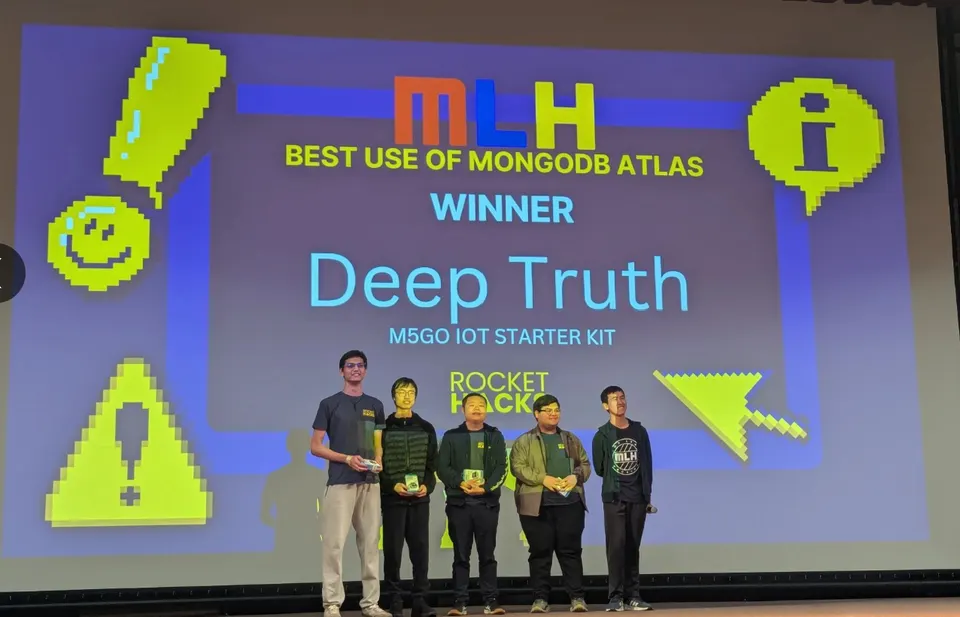
The goal was never to replace human judgment. The goal was to give users a faster first-pass credibility tool - one that helps them think critically before trusting or sharing information. DeepTruth won Best Use of MongoDB Atlas at RocketHacks 2025.
Misinformation spreads because verification is slow
The internet makes information easy to access but difficult to trust. Misleading headlines, AI-generated content, and low-quality sources spread quickly because users often see claims without context, source comparison, or evidence-based verification. Most people do not have time to manually investigate every article they encounter.
Headlines are designed to drive clicks, not accuracy. Framing alone can bias how a claim is understood.
Fact-checking sites exist but require manual navigation - creating friction that most users skip.
Synthetic text can look credible and pass casual inspection, but carries no ground-truth accountability.
Users rarely know who is behind a claim or whether the source has a history of corrections.
Social media rewards speed - content spreads before it is verified, and retractions rarely catch up.
Readers often rely on one outlet rather than cross-referencing multiple independent sources.
DeepTruth addresses this by turning fact-checking into a faster, AI-assisted workflow - reducing the friction between encountering a claim and getting credibility context for it.
Two interfaces, one credibility pipeline
DeepTruth provides two primary user interfaces that feed into the same backend analysis pipeline.
- Users input article titles or claims directly
- Returns credibility score, veracity assessment, reasoning, and independent source links
- Designed for direct claim verification before sharing
- Brings credibility analysis directly into the browsing workflow
- No need to leave the article page to begin verification
- Meets users where misinformation actually appears
Both interfaces connect to the same Django REST API, which orchestrates Gemini AI reasoning, DistilBERT classification, and source verification before returning a structured result to the user.
API endpoints
/api/verify-claim/Analyze an article title or claim - returns credibility, veracity, reasoning, and source links.
/api/false-news/Retrieve previously analyzed or flagged claims stored in MongoDB.
Model fusion over single-signal trust
The core technical decision behind DeepTruth is model fusion: combining two complementary AI systems rather than relying on one signal. A single model is both overconfident and undercalibrated for the complexity of credibility assessment.
Weighted fusion: 70% Gemini / 30% DistilBERT
More weight goes to Gemini because reasoning and explanation quality are primary user-facing values. DistilBERT adds a specialized classification signal without dominating the output.
Google Gemini Pro handles high-level reasoning, claim interpretation, and explanation generation. It produces human-readable analysis of why a claim may be credible or suspicious - not just a score, but the reasoning behind it.
A fine-tuned DistilBERT model provides NLP-based veracity classification. Trained on approximately 9,500 data points, it adds a language-model signal specialized for misinformation patterns that complements Gemini's broader reasoning.
A single model produces overconfident outputs. By combining Gemini's reasoning with DistilBERT's classification, DeepTruth surfaces more calibrated credibility signals - and makes the system more honest about what it knows and does not know.
Full-stack from browser to model inference
The system flows from user input through two interface layers, a REST API backend, AI inference, MongoDB storage, and back to a structured result.
What DeepTruth runs on
What a 24-hour build teaches you
Building DeepTruth under hackathon constraints produced sharper design decisions than a longer timeline might have allowed. A few lessons that stuck:
A score without reasoning is just noise. Users need to understand why the model flagged something before they can decide what to do with that signal.
Trusting a single model produces overconfident outputs. Fusing two systems forces the architecture to be explicit about uncertainty and weighting choices.
Misinformation appears during browsing. A standalone fact-checker that requires a separate tab creates friction - an extension removes it.
Connecting DistilBERT inference, Gemini API calls, MongoDB writes, and Chrome extension communication simultaneously under time pressure revealed integration debt quickly.
Working code is necessary but not sufficient. The ability to communicate the problem, the audience, and the design tradeoffs clearly was as important as the implementation.
Framing matters. A tool that claims to decide truth is both overreaching and less credible than one that claims to help users think more carefully.
The demo was the easy part. Getting DistilBERT inference, Gemini API calls, MongoDB writes, and the Chrome extension to talk to one another - all at once, on a 24-hour clock - is where the integration debt piled up fastest.
The 70/30 fusion reasons from what the two models already know - neither one actually retrieves evidence. I'd add a RAG step before the explanation so a verdict cites fetched sources instead of leaning on model priors.
DeepTruth should be read as an AI-assisted credibility platform, not an absolute truth detector.
“DeepTruth provides credibility signals, reasoning, and independent sources to support critical thinking.”
Where DeepTruth goes next
The hackathon prototype establishes a working pipeline. Future versions could transform it into a much more powerful misinformation-detection platform.
- RAG pipeline for evidence retrieval from trusted sources before generating explanation
- Source credibility database with reliability history, bias indicators, and correction patterns
- Explainability dashboard showing which tokens influenced the verdict
- Deepfake detection for images, video, and audio
- Reinforcement learning feedback loop using user ratings to improve scoring
- Claim clustering to detect repeated misinformation narratives across articles
- Browser-level non-intrusive warnings for highly suspicious headlines
- Multi-language support for international misinformation detection
- Model improvement pipeline using MongoDB-stored claim history as training feedback
The goal is not to replace human judgment. The goal is to give people faster credibility signals, clearer reasoning, and independent sources so they can think critically.
In a world full of noise, DeepTruth helps users slow down before they believe or share.