Camel Car
Chemical propulsion. Pressure-triggered stop. No second chances.
University of Toledo's Chem-E Car competition vehicle - CO₂-powered propulsion, H₂O₂ decomposition stopping, and Arduino-based pressure-threshold control. Competed at the 2025 AIChE Annual Student Conference in Boston against teams from across the globe.
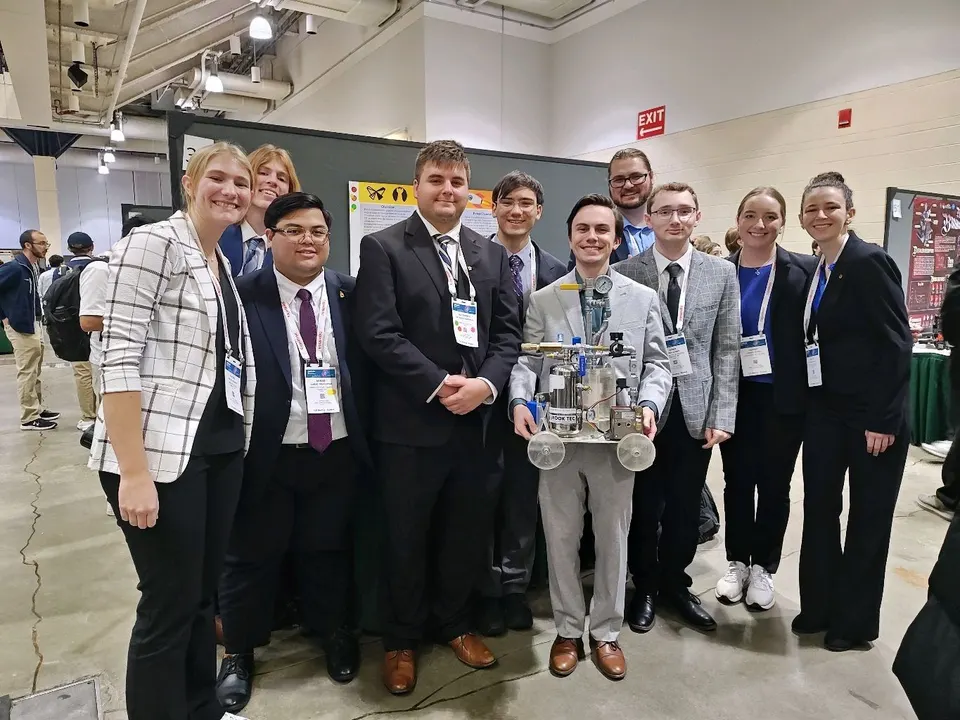
The chemistry creates the signal. The control system makes it repeatable.
Camel Car is the University of Toledo's Chem-E Car competition vehicle. The car travels a target distance using chemical energy and stops using a controlled chemical reaction - no batteries, no conventional brakes. Two separate reactions drive the system: CO₂ generation for propulsion, H₂O₂ decomposition for stopping.
As Control Team Lead, my contribution was the embedded layer connecting these chemical processes to reliable vehicle behavior. An Arduino monitors the stopping reaction pressure, compares it to a target threshold, and triggers a solenoid to cut gas flow to the motor when that threshold is reached. The calibration work - mapping KI catalyst volume to pressure rise time - is what turns a chemical process into a predictable stop distance.
The team qualified for and competed at the 2025 AIChE Annual Student Conference in Boston, representing UToledo on the world stage against teams from across the globe.
Boston, 2025 - competing worldwide
The Most Innovative Car Design award recognized the team's approach to the stopping-control problem: using chemical pressure as a control signal rather than a timing-only mechanism, and building a calibration workflow that could be tuned to any competition distance.
Stop accurately at a distance you don't know until competition day
In Chem-E Car, the challenge is not simply making a car move. The challenge is making it stop at a target distance that is revealed close to competition time - with no conventional electronics, motors, or braking systems allowed. The car must use chemical energy, and the stopping mechanism must be based on a chemical reaction.
The exact stop distance is not known in advance. The team must have a calibrated way to tune the system quickly on competition day.
Reaction rates depend on concentration, volume, temperature, and mixing - all of which vary between runs.
Sensor readings are not perfectly clean. The controller must trigger reliably despite signal variation.
The solenoid has a mechanical response delay between trigger and gas cutoff.
The car continues moving after the gas stops. Coast distance must be factored into the calibration.
The system operates with oxidizers, acids, and pressurized gas - safety limits every design decision.
One reaction drives it. One reaction stops it.
Camel Car uses two independent chemical reactions, one for each function of the vehicle. The propulsion and stopping subsystems operate in parallel - the car begins moving as the propulsion reaction feeds gas to the motor, and the stopping reaction begins building pressure simultaneously.
Propulsion - CO₂ generation
Acetic acid and sodium bicarbonate react to generate CO₂ gas, which is fed through a pressure regulator and flow valve into an air motor that drives the front axle.
Stopping - H₂O₂ decomposition
Hydrogen peroxide is decomposed by potassium iodide acting as a catalyst. The reaction produces oxygen gas, raising pressure inside a sealed reaction vessel. When the pressure reaches the control threshold, the Arduino cuts gas flow to the motor.
H₂O₂(aq) + OI⁻(aq) → H₂O(l) + O₂(g) + I⁻(aq)
This makes the stopping mechanism a chemical-electrical-mechanical hybrid loop: chemistry generates pressure → sensor reads pressure → Arduino compares to threshold → solenoid cuts gas → car decelerates and coasts to stop.
Threshold-triggered embedded stopping
The control system is deliberately simple: a threshold-triggered loop running on an Arduino. Simplicity matters in competition - a system that fails silently is worse than one that is easy to debug in two minutes.
Control loop
Core logic
read pressure_sensor;

if (pressure >= target_pressure_threshold) {
    close_solenoid_valve();
    stop_gas_flow_to_motor();
}
A production-grade version accounts for sensor noise (low-pass filter or moving average), hysteresis to avoid false re-triggering, actuator delay compensation, and a safety cutoff that fires the stop regardless of pressure if a maximum run time is exceeded.
KI volume maps to stop distance
Calibration is the core engineering challenge that makes or breaks a competition run. The chemistry does not produce the same pressure curve every time - concentration, temperature, and mixing all introduce variability. The team's job is to characterize that variability and build a tuning method that works under competition conditions.
More potassium iodide catalyst accelerates H₂O₂ decomposition, which increases the rate of O₂ production and raises pressure faster. Calibration maps a specific KI volume to an expected time-to-threshold at ~5 psi.
Faster pressure rise → earlier Arduino trigger → car stops sooner → shorter travel distance. On competition day, the target distance is converted into a required time-to-threshold, then mapped to a KI volume via the calibration curve.
Safety is an engineering constraint, not an afterthought
Every design decision in Camel Car operates under safety constraints. The chemicals involved - hydrogen peroxide (strong oxidizer), potassium iodide, acetic acid, and pressurized gas - require careful handling at every stage of testing and competition.
Strong oxidizer - requires gloves, goggles, and controlled handling. Skin contact causes immediate bleaching. Stored away from organic materials.
KI is the catalyst. As the reaction proceeds, molecular iodine (I₂) can form - which is toxic and staining. PPE required throughout.
Corrosive at high concentrations. Fume hood use required during preparation. Avoid inhalation.
CO₂ and O₂ generation under sealed conditions. All connections must be leak-checked before each run. Relief valve behavior must be understood.
The air motor and axle create mechanical hazard during live runs. Test area must be cleared.
The shutoff must be reliable - a control failure that leaves gas on is a pressure and chemical hazard, not just a competition loss.
Required PPE: lab coat, safety goggles, chemical-resistant gloves, closed-toe shoes, long pants, fume hood for preparation. All testing followed controlled procedures with a checklist.
What competition-grade embedded work teaches
The threshold-trigger approach is basic control theory. What made it competitive was the calibration data behind it - knowing exactly what KI volume maps to what stop distance under what conditions.
Reaction rates depend on temperature, mixing quality, concentration precision, and timing. The control system must tolerate that variability rather than assume perfect inputs.
Pressure readings are only useful if we know what pressure value corresponds to what motor behavior. That mapping comes from test runs, not datasheets.
The electronic stop trigger is not the same as the mechanical stop. Calibration must account for how far the car travels after gas cutoff.
Chemistry, mechanical design, and embedded control are tightly coupled. A change in KI concentration, a new solenoid, or a different regulator changes the calibration. Every team member needs enough context across disciplines to communicate tradeoffs.
Unknown target distance, one-shot execution, and real chemical hazards force engineering decisions that open-ended projects never surface. Design for worst case.
The competition controller read raw pressure and fired at ~5 psi - no filtering, no hysteresis, no logging. Between chemical run-to-run variability, sensor noise, solenoid actuation delay, and post-cutoff coast, that bare threshold never mapped cleanly to a stop distance on its own. The calibration table existed precisely because the controller couldn't be trusted alone.
Log every run and trigger on the pressure slope, not just the level. We tuned against a stopwatch with no on-car recording; writing pressure to an SD card each run - plus a low-pass filter and hysteresis - would let the calibration come from real traces instead of timed guesses.
Where the control system goes next
The current threshold-trigger design works under competition conditions but has room for significant improvement, especially in repeatability and diagnostics.
- Add pressure data logging to every run (SD card or serial)
- Apply low-pass filter or moving average to reduce sensor noise
- Add a second pressure sensor for redundancy
- Add temperature sensing to correct for reaction-rate variation
- Add hysteresis to prevent false re-triggering near threshold
- Model and compensate for actuator delay
- Add a maximum-run-time safety cutoff independent of pressure
- Build a predictive stopping algorithm that uses pressure slope, not just level
- Build a calibration dashboard: KI volume → time-to-threshold → stop distance
- Add wheel encoder data to measure actual travel distance per run
- Add IMU to detect acceleration and vibration patterns
- Add environmental correction for temperature and humidity
The chemistry creates the signal. The control system is what turns that signal into a repeatable vehicle action.
Camel Car shows that embedded control, calibration, and safety engineering are not just software problems - they are the bridge between chemical energy and competition-grade performance.